'Side by Side' reflects a watershed moment in the history of film
The great celluloid vs. digital debate really opens up for the layman
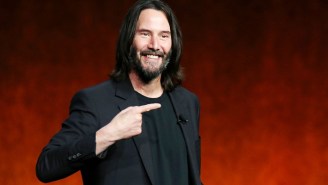
Keanu Reeves (left) and Martin Scorsese in "Side by Side"
Are you a fan of In Contention?
Sign up to get the latest updates instantly.
I'm not really sure what's left to be said in the great film vs. digital debate, but if nothing else, Christopher Kenneally's "Side by Side" brings things to a head nicely as it represents the layman's way into the discussion. These things always reach broader consideration last and no film, to date, has been as thorough and definitive as this.
A year after "Hugo" brought concepts of film preservation into a narrative fold and fed a meta fire throughout a season very much about Hollywood and the history of cinema, the debate rages on. That film's director, Martin Scorsese, the great protector of celluloid, appears to be throwing in the towel, while recent pop-up screenings (with one more still to come) of Paul Thomas Anderson's "The Master," shot on 65mm, doubled as a benefit for Scorsese's film preservation-dedicated Film Foundation. These are very divided, even contradictory times.
Partly that's what makes "Side by Side" so interesting. It never takes sides. It uses the thoughts and considerations of today's filmmaking talent -- a wide swath including Scorsese, George Lucas, David Fincher, Steven Soderbergh, Danny Boyle, Richard Linklater, James Cameron, Christopher Nolan and David Lynch, as well as cinematographers such as Michael Ballhaus, Anthony Dod Mantle, Dick Pope and Wally Pfister -- to convey a watershed moment in history.
Related
-
Watch: Keanu Reeves shares some insights on the digital vs film debate in 'Side By Side'
A preview of a long-form interview we'll be running next week
And it doesn't pigeonhole their opinions, either. None of these guys are putting on blinders and ignoring the big picture. They know the pros and cons of each philosophy better than probably anyone, and to hear them wax on about it is indeed required viewing for film fans.
There is a healthy debate to be had about the photochemical process being at its end and, therefore, the need to grow and advance the digital process, as well as the dangers of a digital Dark Ages where content is lost to the obsolescence of technology while celluloid remains the best form of preservation. And this film has that debate. It hangs it all out there without deigning to aim for an answer.
But most riling to me in the film is when discussion among celluloid proponents leans toward a gatekeeper, keys-to-the-kingdom mentality. The sense that digital has sparked an anyone-can-do-it revolution clearly chafes for some of these people. Indeed, one of the most annoying comments of the entire film -- I forget the talking head -- was, "There isn't a taste-maker involved." Producer/narrator/interviewer Keanu Reeves's "wow" in response was the nice way of putting it.
So we move into another season that could certainly keep the debate sparked. Films representing a wide range of celluloid like "The Master" (70mm*), "The Dark Knight Rises" (IMAX) and "Beasts of the Southern Wild" (16mm) will square off against equally diverse digital offerings like "Life of Pi" (Arri Alexa), "Flight" (Red Epic) and "The Hobbit: An Unexpected Journey" (Red Epic). Great DPs like Roger Deakins ("Skyfall") will move further into the digital realm after getting their toes wet only recently, while others will continue to dig in and stick with the film process they feel is superior.
It's an exciting time in the history of cinema. And no one has the answers. Perhaps that's precisely what makes it so exciting.
"Side by Side" is now playing in limited release. It hits Video On Demand on August 22.
*Some have expressed confusion over the 65mm/70mm thing, so if you're one of those, it's as simple as this: A 70mm production is shot on 65mm film. It is exhibited in 70mm. The extra 5mm is for the soundtrack.
Trending Now on HitFix Boards
| Topic | Started By | Latest Post | Replies |
|---|---|---|---|
| DarylRichardson |
3 months ago
|
1
|
|
| gregel |
7 months ago
|
9
|
|
| Discuss Oscars on HitFix Message Boards » | |||
2012-2013 OSCAR PREDICTIONS
Best Picture
Best Director
Best Actor
Best Actress
Best Supporting Actor
Best Supporting Actress
Best Adapted Screenplay
Best Original Screenplay
Best Cinematography
Best Costume Design
Best Film Editing
Best Makeup And Hairstyling
Best Original Score
Best Original Song
Best Production Design
Best Sound Editing
Best Sound Mixing
Best Visual Effects
Best Animated Feature Film
Best Documentary Feature
Best Foreign Language Film
Latest Posts
-
Michael Douglas and Matt Damon excel in Soderbergh's witty Liberace biopicTuesday, May 21, 2013
-
The actor-director gets all the best close-ups in his Faulkner adaptationMonday, May 20, 2013
-
'Traumatized critics exhale.'Monday, May 20, 2013
-
The prestige distributor also handled Asghar Farhadi's 'A Separation'Monday, May 20, 2013


Comments
Option 1
Comment instantly as a guest GuestOption 2
Option 3
Login or create a HitFix account Login SignupJoe
August 18, 2012 at 3:05PM EST Reply to CommentThere is definitely a certain aesthetic beauty to film that remains unique in scope, but in recent years, I have come to accept the digitization of cinema. When film enthusiasts, such as Scorsese and Malick, are stepping into this new wave, then we know that film is on its true decline. The major issue I have with this is that distributors are forcing all theaters to switch to digital by January of 2013, meaning independent cinemas who cannot afford such an expensive endeavor could be shut down. We need more time for this change. Please be lenient; there is no cinema without the heart of independently-owned theaters.
Kristopher Tapley Well said.
August 18, 2012 at 3:39PM ESTMaxim "When film enthusiasts, such as Scorsese and Malick, are stepping into this new wave, then we know that film is on its true decline."
August 19, 2012 at 3:05PM ESTThat's not true... It's when people, especially those who grew up with film get sold on the idea that the merits of digital cinema is tied to a handful of filmmakers is when you know the film is on decline.
I think that you may be putting too much stake on Scorsese and Malick to be able to make a decision of that nature, especially if all they are doing is experimenting with something new (or is the reality may be, are simply going with a cheaper alternative to get their film made).
You are also, if not exactly confusing cause and effect here, are overlooking the fact that statements like the one above are true enabling forces of this digital revolution. Digital is a valid alternative as long as people believe that it is. And if it's an alternative then the more expensive tech will fall out. Only time will tell if film can become a complement much like LPs are a complement to digital music.
DefRef
August 18, 2012 at 4:22PM EST Reply to CommentI've noticed the gate-keeper aspect as well; it sounds similar to people in the music industry who bemoaned the rise of inexpensive digital technology that put professional quality into people's bedrooms and laptops and mooted the need for $300/hour recording studios. As with film/digital, there are pros and cons of either method, but what I think scared them was the idea that someone could cut out the middleman and connect directly with an audience and deprive them of the traditionally unfair deals that enriched them at the expense of everyone else.
As for digital filmmaking, I have the same attitude as I did with music: On the plus side, financial limitations aren't an impediment to anyone making a record/movie; on the negative side, financial limitations aren't an impediment to anyone making a record/movie. But I'd rather have a thousand lame hacks running around and clogging YouTube and Vimeo with their nonsense than have the next [fill in your favorite filmmaker] go unable to discover their talent because they couldn't afford the tools.
I was never able to make Super 8 films back in the late-Seventies because my family was very poor and the was simply no money for such frivolity. Nowadays, you can get a HD digital camera for $100 and edit with the rudimentary programs that come free with every computer or spend another C-note for Premiere Elements. Sure it won't be megaplex quality, but you can learn to write, compose shots, work with actors (i.e. family and friends), edit and tell a story without having to spend $30,000 on film school and selling blood/turning tricks to pay for film and processing.
Paranormal Activity's original budget was something like $7000 IIRC (before the Spielberg-mandated reshoots which doubled the budget to $15,000) and that included the cost of the camera and the computer and software it was edited on! One of the biggest expenses was renting the cop uniforms. What was the ROI for that compared to John Carter, hmmm?
/3rt
August 18, 2012 at 4:56PM EST Reply to CommentI feel the film enthusiasts are denying themselves the joy of inevitable improvements digital technology inherently operates from . Moving into the realm of sci-fi dreamed excellence. Of course politics from studios and manufacturers can cripple the best intentions from the innovators of equipment and software.
/3rt
August 18, 2012 at 5:05PM ESTI feel film enthusiasts are denying themselves the joy of inevitable improvements digital technology inherently operates in. Moving in the realm of sci-fi dreamt excellence. Of course studio and manufacturer politics can cripple best the intentions of software and equipment innovators.
Al
August 18, 2012 at 10:02PM EST Reply to CommentI accept digital no problem, if thats what the DPs or directors want to use thats fine by me. I just prefer film and I prefer movies projected in film if thats how they were shot. I don't know if its mind over matter or what, but I can't stand digital projection.
Ben M.
August 19, 2012 at 12:22AM EST Reply to CommentFrom the get-go, I've thought digital projection was far better than any film projection I've seen, other than 70MM IMAX. But I do have some mixed feelings about forcing theaters to go digital, as most of the theaters I find that still use film projectors are the small, non major chain ones, which I know are often in danger of going out of business anyway. Yet, I'll admit I would always choose to see a movie in digital over film projection if presented with the choice (in fact I did such a thing with Dark Knight Rises, as I asked the theater nearest to me which had DKR on two screens, one digital and one film, which time the digital showing was before buying my tickets), and a number of recent times I've found my moviegoing experience suffered because of film projection, sometimes it can be more minor problems (as happened with Ruby Sparks and Cabin in the Woods) but others I've found that the film takes a huge visual hit under those projectors (as I noticed with Deep Blue Sea and To Rome With Love).
As far as shooting goes, until the last few years I've always thought film was superior and even mostly impressive looking digital shot movies such as Benjamin Button still had a few shots which felt off, but I do think digital cameras are really improving now to the point where I feel many of the best looking pictures are shot digitally.