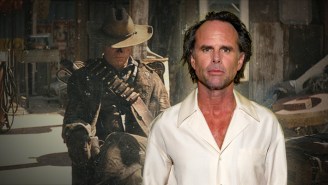
Woody Harrelson takes on the politics of politics in ‘Hunger Games’ and ‘Game Change’
The actor's two seemingly incongruous roles point to a gaping cultural wound
Woody Harrelson as Haymitch Abernathy in "The Hunger Games."
Are you a fan of In Contention?
Sign up to get the latest updates instantly.
When Woody Harrelson signed on to play Steve Schmidt and Haymitch Abernathy in “Game Change” and “The Hunger Games” respectively, he likely wasn’t thinking that the roles are actually strange mirrors of one another (although, who’s to say what Harrelson is thinking really?). Aside from the obvious similarities - both films are adaptations of books and they each have the word “game” in the title - there are some equally clear distinctions.
Steve Schmidt is, of course, the campaign strategist who functioned as the senior adviser on the 2008 John McCain Presidential bid. Haymitch Abernathy is a fictional character who resides within the world of author Suzanne Collins's novel “The Hunger Games,” an imagined dystopic future where North America has been reduced to a conglomerate of 12 “districts” which are presided over by a dangerously self-indulgent “Capitol.”
Schmidt is a successful, high-functioning leader of the Republican Party. Haymitch Abernathy is a man who was psychically fractured in his youth (by his participation in the games) and is an intractable, erratic adult who spends the large majority of his time buried in the depths of a bottle.
“Game Change” focuses on Schmidt and Team McCain’s selection of Alaska Governor Sarah Palin as the Senator’s running mate, the subsequent coaching that the team was required to do to prepare the grossly underprepared and unqualified candidate and the realization that they had, inadvertently, created a monster within their party. “The Hunger Games” is a political allegory that uses a fantasized version of our future and an exaggerated set of circumstances to highlight (among other things) the egregious discrepancy between the 1% and 99%.
In the latter, war and natural disasters have ravaged the earth, leaving a far smaller population and physical landscape in the wake of the chaos. North America, now the country of Panem, is comprised of (as mentioned) 12 distinct and impoverished districts that rarely interact. Each produces its own “specialty” (meaning resource that they provide to the Capitol), whether it be coal (district 12), fabrics (district 8) or luxury goods (district 1). The transfer of the resources from the have-nots to the have-too-much-time-on-their-handses is one of the ways in which Collins highlights some of the existing disparities in our world and points to an ever widening chasm between the rich and the poor.
As a remembrance of a long ago attempt at rebellion, a reminder of the scope and power of the Capitol’s authority and a warning to those who may hope to challenge it, the Capitol demands that all districts deliver one boy and one girl “tribute” to participate in a yearly televised fight to the death: the Hunger Games. Haymitch is the only living district 12 survivor of the games and as such is tasked with preparing Katniss and Peeta, the two children selected from 12, to play and win against nearly insurmountable odds.
Related
-
Julianne Moore owns Jay Roach's 'Game Change' as Sarah Palin
The actress gives one of her finest performances to date in the HBO adaptation
-
Interview: Woody Harrelson talks Hitler jokes, eating raw, politics... oh, and 'Rampart'
He also can't believe he gets to make Christopher Walken laugh
The central character, Katniss (Jennifer Lawrence), is a grounded and unselfconscious girl, unselfconscious in the sense that she has no ability to discern her impact on those around her. She has no wish to charm a crowd, to adopt a persona, and has little regard for what others may or may not make of her - until it becomes a matter of life or death. Game playing is as unnatural to her as it is (seemingly) inherent for Palin. She acts from unbidden instinct, often the base instinct to survive both in body and in spirit and in so doing she becomes an unwitting revolutionary.
It is Haymitch’s job to find a persona for Katniss, one that will work to please the avaricious Capitol audience who want nothing more than “a good show,” for it is their donations of food, medicine and water during the games that will strengthen her bid to stay alive. The audience expects an entertaining player too cheer on. The realities of Katniss's character are of very little interest to them, however.
Are the mirroring qualities beginning to emerge a bit?
Katniss and Palin are two sides of a coin just as Haymitch and Schmidt are. Each man played Pygmalion in some sense to the women in their charge. Each was called upon to play the "game" of politics, one in an attempt to win an election and one to keep a teenage girl's heart beating. They are the designers of figureheads. Pailn became a reflection of the people for many members of the Republican party as Katniss becomes a symbol of a revolutionary spirit in "The Hunger Games." Haymitch's machinations and Katniss's role as a political unifier evolves as the series of books does.
Each woman was tasked with painting a portrait for an audience that had lost all sense of legitimate priorities and of reasonable expectations from their leadership: a thirsty crowd that wants little more than, as mentioned, “a good show.” Collins is, perhaps in part, imparting a warning with her trilogy. I do not believe that it supports a particular “party line,” quite the opposite in fact. It eventually illustrates the inherent error in aligning oneself too closely with any rigidly constructed ideological organization. She favors fundamental humanity, the individual and, well, sanity.
But the parallels between the Capitol - a small group so bloated with excess, distraction and diseased values that they fail to see (or take offense to) the struggle that the majority of their fellow human beings, or they themselves, are subjected to - and some of our cultural and geopolitical realities are hard to miss. Collins seems to be saying with her book: “This outcome is unlikely but possible in the coming years if we do not awaken to the fact that there are inequities that must be addressed and things that ought to be held sacred rather than reduced to the ephemeral mists of entertainment and celebrity.”
In the film, the population is controlled in three key ways: an enforced separation and nurtured hostility between the districts (which distracts them from all that could unite them and thus make them stronger), a large measure of fear tempered with a small measure of (mostly unrealistic) hope and (in the wealthiest sections) a limited understanding of the outside realities and a focus on the superficial and celebrity culture. They relish the razzle dazzle and dismiss the blood, bones and bread of human existence. In their perception, life, death, entertainment and politics all bleed into one.
Haymitch Abernathy and Steve Schmidt both endeavor to get the world at large to “buy into” their respective mentees. But, again, one is a power grab with potentially disastrous consequences and the other a bid for survival. The interesting part of these paradoxically perpendicular and parallel storylines is that the mistakes the McCain campaign made by choosing to focus on and nourish division, greed and shallow presentation rather than substance when they selected and groomed Palin is precisely what the Collins series (in part) warns could lead to our peril.
Now, we do not literally equate the 2008 Republican primary to a grotesque teenage bloodbath, but metaphorically, perhaps. As “Game Change” depicts it, the McCain campaign became so focused on winning that it lost track of its true value and what it is everyone involved were trying to accomplish. Unusual in politics? Clearly not.
But Harrelson’s Schmidt backs a woman he knows could mean the ruin of the nation he loves in order to do so. He attempts to craft her into a shiny package the citizenry will happily purchase despite its lack of true nourishment. She is a distraction, a glittering toy dangled before children who seemingly fail to see that their own good is being disregarded.
Harreslon's Haymitch Abernathy is forced to shape a young girl of unusual substance and little artifice into an image that a fat, self-centered, shallow populace that has become blind to even the basic tenants of moral integrity can "root for" in a sick approximation of "reality TV." He does so because he knows, whether she is aware of it or not, that Katniss can be a beacon to the many who suffer greatly at the hands of the few. Where Katniss is an unwilling symbol who would rather live an actual life, Palin was "the best actress in politics," a woman who (in this rendering) revered fame for fame's sake and had little interest in the true business at hand: serving the people.
Palin's toxic narcissism is dangerous to those who would allow her to govern them while Katniss’s unflinching honesty makes her a reluctant but worthy leader. But in each case, it is the populace’s poisoned value system and obsession with the shallow veil of contrived "personalities," sensation and flash that leads to their ultimate decline.
Perhaps Harrelson - quite the socio-politically-minded individual - consciously meant to point to a gaping cultural wound when he took on these respective roles. Perhaps not. But for some of us, that’s just what he did.
For year-round entertainment news and commentary follow @JRothCon Twitter.
Sign up for Instant Alertsfrom In Contention!
Trending Now on HitFix Boards
| Topic | Started By | Latest Post | Replies |
|---|---|---|---|
| sandylewis90 |
2 months ago
|
1
|
|
| sandylewis90 |
4 months ago
|
1
|
|
| Discuss Movies General on HitFix Message Boards » | |||
2012-2013 OSCAR PREDICTIONS
Best Picture
Best Director
Best Actor
Best Actress
Best Supporting Actor
Best Supporting Actress
Best Adapted Screenplay
Best Original Screenplay
Best Cinematography
Best Costume Design
Best Film Editing
Best Makeup And Hairstyling
Best Original Score
Best Original Song
Best Production Design
Best Sound Editing
Best Sound Mixing
Best Visual Effects
Best Animated Feature Film
Best Documentary Feature
Best Foreign Language Film
Latest Posts
-
Audiences revisit Celine and Jesse this weekendFriday, May 24, 2013
-
Marion Cotillard and Joaquin Phoenix play out a bad romance in 1920s-set dramaFriday, May 24, 2013
-
Matthias Schoenaerts the ensemble standout in overlong period thrillerFriday, May 24, 2013
-
This one looks poised for an awards runThursday, May 23, 2013


Comments
Option 1
Comment instantly as a guest GuestOption 2
Option 3
Login or create a HitFix account Login Signupevolution1085
March 26, 2012 at 1:28PM EST Reply to CommentWow... sounds like somebody's reading WAYYYYYY too much into the socio-economic commentary of a teen book that's essentially ripped off a wide range of historical/narrative tropes.
Kristopher Tapley Sounds like someone else is afraid of reading things into art, aka, thinking.
March 26, 2012 at 1:37PM ESTevolution1085 It's not thinking when your placing your own interpretations of what the author was going for in her work... when you can go ask the author "excuse me, miss collins, did you intend your work as a scathing dismissal of our current celebrity/materialistic culture, or was it a literary equivalent of the great illustrated classics version of battle royale"
March 26, 2012 at 2:32PM ESTKristopher Tapley She offered her interpretations, backed them up and, by publishing, put it out to an audience to chew on and/or add their own thoughts.
March 26, 2012 at 2:43PM EST"placing your own interpretations of what the author was going for in her work"
This is the essence of subjectivity. If it can be gleaned (it certainly has in other outlets outside of this one, so your indignation is strange), it's fair to put it out there.
So yeah, you're clearly against thinking, discourse, conversation, etc. For some reason you'd rather shut it all down. You have, as a result, added zero to the mill here, so just feel free to go off and plug your ears and avoid educated discussion and debate elsewhere. Kind of pointless to be oddly whiny here.
Unless, of course, there's something specific, an issue with what's here, perhaps, that you'd like to raise. Then at least we'd be moving forward with things.
Roth Cornet Have you read the books? Genuine question because the games themselves are there to serve the larger story. They are there to illustrate aspects of the world and the characters. Other than the obvious similarity in the set up (teenagers fight to the death) The Hunger Games and Battle Royale are actually very different beasts.
March 26, 2012 at 3:09PM ESTevolution1085 1. I've read the books... they're not art. If they're art, then twilight is a russian classic and the Da Vinci Code is Shakespearian in quality. The entire series is built for entertainment, or else we wouldn't have spent as much time inside Katniss' mind over her debate with Peeta/Gale.
March 26, 2012 at 3:24PM EST2. Katniss herself isn't even all that appalled by the capitol, as she herself humanizes her style team while the rest of the rebels/District 13 are ready to string them up as being part of "the establishment" (which would be the closest parallel one could make to the ideas of OWS).
3. She's ascribing intent to an author, which isn't subjective at all, as the author's POV and narrative choices are entirely objective to her. She's trying to make a point (or not trying to make one). It's like going into a museum, seeing a painting, and then creating a narrative about the work based on your personal experiences/philosophies. Then you talk to the artist, and you find out that they just liked those particular aesthetic choices. That other interpretation, while useful for that person to digest the work, isn't worth all that much because the author ultimately maintains ownership of the idea, no matter how popular any other interpretations are.
I heard Donald Sutherland being interviewed today talking about how "the hunger games is a movie for the 99%". That's someone taking their politics and attaching a point of view to the story. For all I know Suzanne Collins could have been going in the complete opposite direction and wanted to tell a love story with a not crappy heroine in a dystopian future... and that interpretation would be correct, because she's the author.
Kristopher Tapley "the author ultimately maintains ownership of the idea"
March 26, 2012 at 7:45PM ESTYikes. Okay, guys. Stop taking things away from pieces of art unless you phone up the author and specifically glean his or her intent. Otherwise, we're all just wrong to be affected in our own ways by art and the word "interpretation" need never have been invented.
What nonsense.
Kristopher Tapley By the way, why is your speculation that the story is NOT a political allegory any more valid than Roth's (widely shared by others who've written about it) speculation that it is?
March 26, 2012 at 8:08PM ESTJoe7827 I think Bernardo Bertolucci would quite disagree with Evolution1085.
March 27, 2012 at 9:40AM ESTKristopher Tapley
March 26, 2012 at 2:46PM EST Reply to CommentBy the way, enough bitching about "Battle Royale" similarities. Did no one see "The Running Man?"
(I haven't even seen "The Hunger Games" yet, mind you. It's just that that criticism is just striking me as incredibly lazy.)
Roth Cornet I causally brought up The Running Man in an interview with Harrelson, Elizabeth Banks and Lenny Kravitz because it has that same element of (well a televised fight to the death) as well as societies emotionally dissociated appetite for violence and voyeurism. Also, I have a very weird affection for that film :).
March 26, 2012 at 3:13PM EST/3rt You like The Running Man and Total Recall! How come you're not writing about the classics?
March 27, 2012 at 2:36AM ESTJohn G. Isn't this story based on the Theseus myth? That was my immediate reaction when I heard the premise.
March 27, 2012 at 9:26AM ESTCorporate Team Building Events & Courses
March 27, 2012 at 5:35AM EST Reply to CommentHello I'm Kevin Clinton.Your thread has a lot of information. Looking forward to see more threads like this.
If you have time you can also visit this site for more information about Corporate Team Building Events & Courses
trytoseeitmyway
May 13, 2012 at 7:25PM EST Reply to CommentIt's hard to understand how the reviewer can gloss over the role of the state in creating and enforcing the dysutopian inequality depicted in THG. The economy is centrally controlled and benefits the elites. Even the name of the nation, "Panem," consciously evokes "panem et circenses" by which the imperial Roman state imposed its will on its own citizens while employing more militaristic means against the provinces. You have to be blind to overlook these elements to see the movie or novels as so-called progressive indictments against the wealthly.
JWnTX
August 20, 2012 at 6:08PM EST Reply to Comment"“Game Change” focuses on Schmidt and Team McCain’s selection of Alaska Governor Sarah Palin as the Senator’s running mate, the subsequent coaching that the team was required to do to prepare the grossly underprepared and unqualified candidate and the realization that they had, inadvertently, created a monster within their party." According to the perpetual consultants who managed to throw the election and then launched a character assassination movie to cover their incompetent asses. Thanks for passing along their canard. It's fantasy, but hey--that's what movies are about, huh?